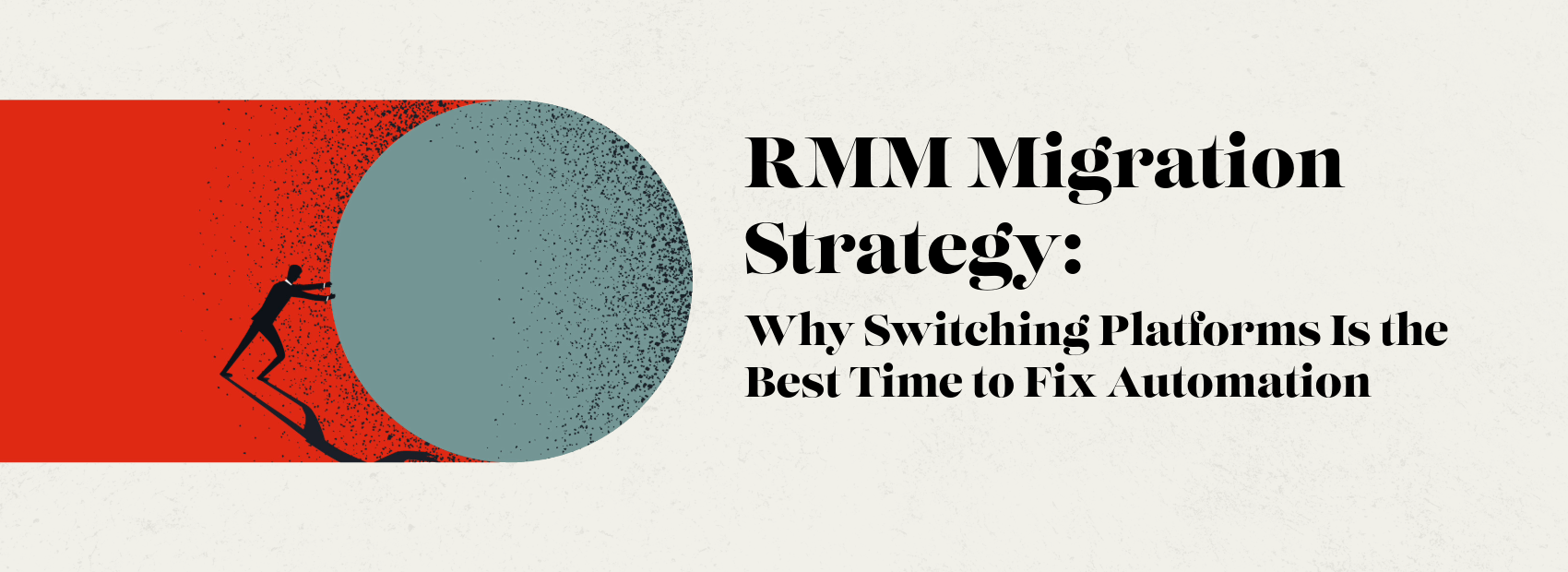
RMM Migration Strategy Automation Starts Before the First Agent Moves
RMM migration strategy automation planning is one of the most overlooked opportunities inside an MSP. Most providers focus on moving agents, rebuilding policies, and restoring monitoring. However, the real value comes from evaluating operational maturity during the transition itself.
That matters because most MSPs carry years of automation drift into a new platform. Old scripts remain active. Monitoring becomes noisy. Patch policies evolve inconsistently. Meanwhile, technicians develop workarounds that nobody documents properly.
An RMM migration creates something rare: a clean operational checkpoint.
It forces MSPs to examine how work gets done.
More importantly, it creates the perfect opportunity to evaluate automation maturity with tools like Samurai Sync MIRA.
Most RMM Migrations Focus on the Wrong Things
Many MSPs approach migrations as a technical project:
- Deploy the new agent
- Remove the old one
- Rebuild monitoring
- Restore patching
- Reconnect integrations
While those items matter, they are only part of the equation.
The bigger question is this:
Are your operational processes efficient today?
In many cases, the answer is no.
MSPs often discover:
- Duplicate scripts
- Conflicting policies
- Manual technician tasks
- Excessive alerting
- Inconsistent patch logic
- Unsupported automation workflows
Unfortunately, migrating these issues to a new RMM only recreates the same operational problems inside a different platform.
That is why the migration process should include operational analysis and an evaluation of automation.
An RMM Migration Is a Rare Reset Opportunity
Most MSPs never take the time to evaluate their environment holistically.
Daily ticket flow gets in the way. Client escalations consume time. Technical debt grows quietly over several years. Eventually, the RMM becomes a reflection of operational survival instead of operational design.
Migration changes that.
Suddenly, every policy, monitor, script, and workflow must be reviewed. Every assumption gets questioned. Every alert path becomes visible again.
That creates an ideal moment to ask:
- Why are technicians still doing repetitive tasks manually?
- Which scripts save time?
- Which automations constantly fail?
- Where does alert fatigue originate?
- Which workflows should be rebuilt entirely?
This is exactly where MIRA becomes valuable.
How MIRA Helps During an RMM Migration
Samurai Sync MIRA helps MSPs evaluate automation maturity across operational functions.
Instead of assigning a vague automation “score,” MIRA looks at how automation affects real business operations.
That includes:
- Endpoint management
- Patch workflows
- Monitoring response
- Ticket handling
- User onboarding
- Compliance tasks
- Technician efficiency
- Escalation paths
During a migration, MIRA helps MSPs identify:
- Existing automation gaps
- Areas of operational friction
- Repetitive manual tasks
- Poorly optimized workflows
- New automation opportunities within the destination platform
This changes the migration from a platform replacement into an operational improvement project.
That is a major difference.
Automation Should Be Evaluated Before Rebuilding It
One of the biggest mistakes MSPs make is migrating automation without validating whether it still makes sense.
Some scripts were written years ago for problems that no longer exist. Others rely on unsupported APIs or outdated assumptions. In some environments, multiple scripts perform nearly identical functions, yet produce inconsistent results.
Blindly recreating this creates long-term instability.
Instead, migrations should include:
- Script audits
- Workflow mapping
- Dependency validation
- Error tracking analysis
- Technician usage review
From there, MSPs can determine:
- What should remain
- What should be rebuilt
- What should be retired entirely
- What new automation should be introduced
That process reduces technical debt dramatically.
Modern RMM Platforms Create New Automation Opportunities
Another reason migrations matter is platform capability.
Many MSPs migrate from older RMM systems because:
- Automation support is limited
- Monitoring lacks flexibility
- Reporting is weak
- Integrations are fragmented
- Patch management is inconsistent
Modern RMM platforms often provide:
- Better scripting engines
- API-driven workflows
- Improved alert logic
- Native integrations
- Enhanced automation orchestration
However, MSPs only benefit if they intentionally redesign workflows.
Otherwise, they simply recreate old habits on newer software.
MIRA helps MSPs identify where the new platform can unlock operational gains that were previously unattainable.
Reducing Alert Fatigue Is an Automation Conversation
Many MSPs believe alert fatigue is only a monitoring problem.
It is not.
Alert fatigue often indicates:
- Poor automation handling
- Weak escalation logic
- Missing remediation workflows
- Inconsistent thresholds
- Lack of operational standardization
A migration creates the perfect opportunity to redesign:
- Auto-remediation workflows
- Escalation policies
- Alert suppression logic
- Self-healing automation
- Notification routing
That directly improves technician efficiency.
More importantly, it reduces burnout.
The Best MSPs Use Migration to Improve Operational Maturity
Top-performing MSPs do not treat migrations as mere infrastructure projects.
They use them to:
- Standardized operations
- Improve automation
- Reduce technician load
- Eliminate operational drift
- Increase scalability
- Improve client consistency
That mindset produces long-term gains beyond the RMM itself.
The platform matters. However, operational discipline matters more.
RMM Migration Should Be a Business Improvement Project
The MSPs that gain the most value from migration understand something important:
Switching RMMs is not just about tools.
It is about fixing operational inefficiencies that quietly hurt scalability, profitability, and technician experience over time.
When combined with automation evaluation through MIRA, migration becomes:
- A cleanup initiative
- An operational redesign
- A standardization effort
- A scalability project
- An automation optimization opportunity
That creates lasting business value.
Final Thoughts
Most RMM migrations focus on replacing software.
Smart MSPs use the process to improve operations.
That is where real transformation happens.
By combining structured migration planning with automated analysis in MIRA, MSPs can reduce noise, improve efficiency, streamline workflows, and build a more scalable service operation going forward.
Because the best time to fix automation is when you already have the hood open.